


-DFE0E5)







Cloud | Documentation | Roadmap | Discord
📕 Table of Contents
RAGFlow is a leading open-source Retrieval-Augmented Generation (RAG) engine that fuses cutting-edge RAG with Agent capabilities to create a superior context layer for LLMs. It offers a streamlined RAG workflow adaptable to enterprises of any scale. Powered by a converged context engine and pre-built agent templates, RAGFlow enables developers to transform complex data into high-fidelity, production-ready AI systems with exceptional efficiency and precision.
Try our cloud service at https://cloud.ragflow.io.
For local deployment, see Local Deployment.


- 2026-09-29 RAGFlow 1.0.0-rc1 released.
- 2026-09-10 Added website content ingestion through sitemaps.
- 2026-08-19 Introduced Knowledge Compilation to generate Wikis, Graphs, Trees, PageIndex, Mind Maps, Timelines, and Skills at the document and dataset levels.
- 2026-08-19 Introduced Agentic RAG with Low, Medium, High, and Ultra thinking modes.
- 2026-07-02 Added Google BigQuery data source ingestion and incremental synchronization.
See the full release notes for more updates.
⭐️ Star our repository to stay up-to-date with exciting new features and improvements! Get instant notifications for new releases! 🌟

- Deep document understanding-based knowledge extraction from unstructured data with complicated formats.
- Finds "needle in a data haystack" of literally unlimited tokens.
- Intelligent and explainable.
- Plenty of template options to choose from.
- Compile content at the document and dataset levels into structured knowledge artifacts.
- Use compilation templates to generate Wikis, Graphs, Trees, PageIndex, Mind Maps, Timelines, and Skills for different knowledge organization and reuse needs.
- Configure compilation models and processing rules, and view, update, and regenerate knowledge artifacts.
- Perform multi-step retrieval for complex questions: the model analyzes the question and, when needed, breaks it down, retrieves knowledge, and verifies evidence.
- Gather more complete context through multiple rounds of retrieval and reasoning to help generate well-grounded answers.
- Choose Low, Medium, High, or Ultra thinking modes to control retrieval and reasoning depth according to question complexity.
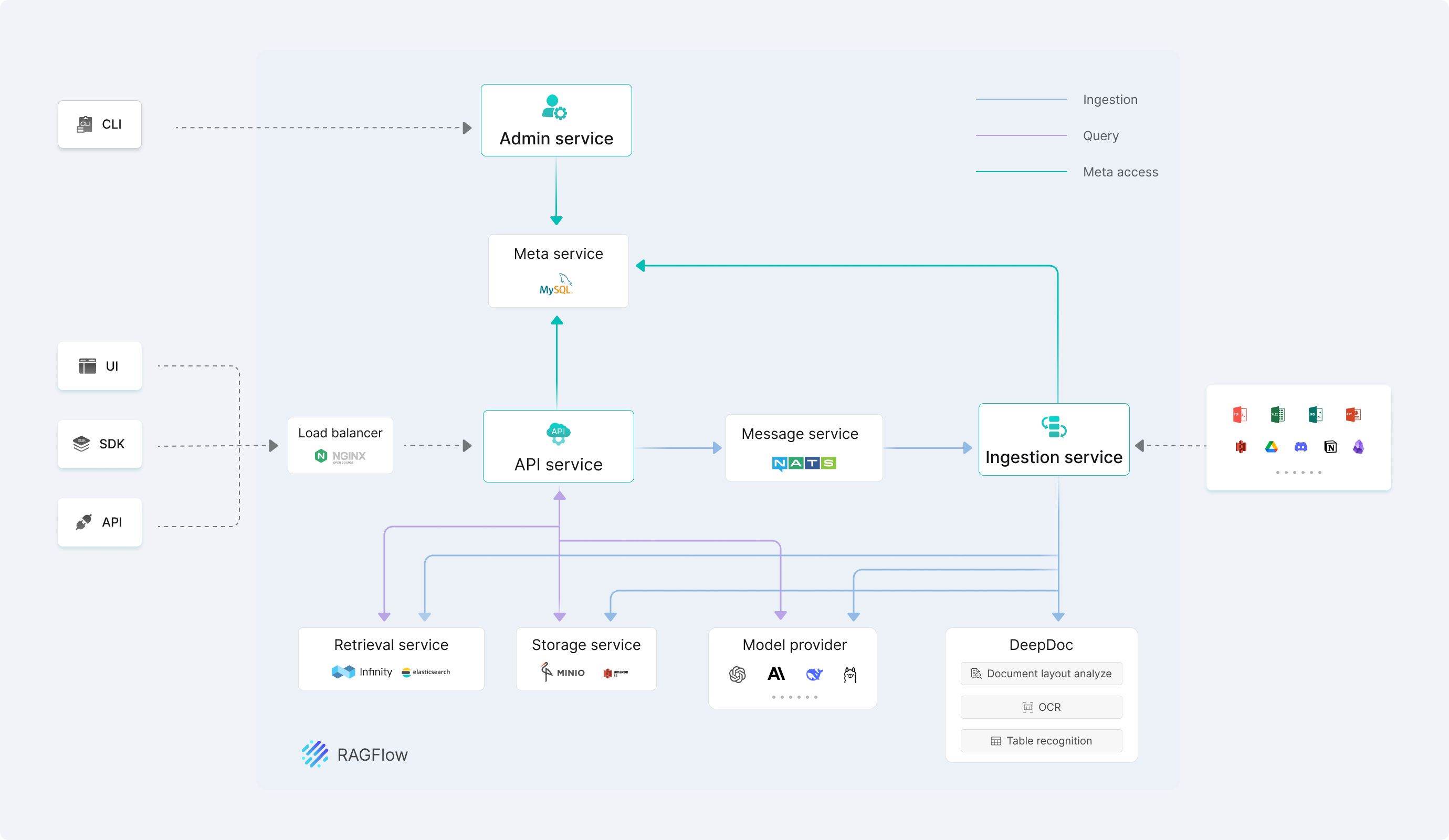
- API, Admin, Ingestor, and Syncer are provided by a unified Go service.
- DeepDoc runs within the Go process and handles layout analysis, OCR, and table recognition.
- Go services use CGO to call native document parsing libraries and ONNX Runtime.
- MCP and Sandbox Executor are optional capabilities that can be enabled as needed.
- Visualization of text chunking to allow human intervention.
- Quick view of the key references and traceable citations to support grounded answers.
- Supports Word, Slides, Excel, TXT, images, scanned copies, structured data, web pages, and more.
- Streamlined RAG orchestration catered to both personal and large businesses.
- Configurable LLMs as well as embedding models.
- Multiple recall paired with fused re-ranking.
- Intuitive APIs for seamless integration with business.
- Recommended starting configuration: 4 CPU cores, 16 GB RAM, and 50 GB of available disk space. Actual requirements depend on the document engine, data volume, parsing tasks, and concurrency. Local models and other optional components may require additional resources.
- Docker >= 24.0.0 & Docker Compose >= v2.26.1
- gVisor: Required only when using the Self-Managed container Sandbox.
Docker deployment does not require Go on the host. Self-Managed container Sandbox requires gVisor; other Sandbox providers do not require gVisor on the RAGFlow host.
Tip
If you have not installed Docker on your local machine (Windows, Mac, or Linux), see Install Docker Engine.
-
If using Elasticsearch, set
vm.max_map_counton the Docker host to at least 262144. This step is usually unnecessary with Infinity:To check the value of
vm.max_map_count:sysctl vm.max_map_count
If you use Elasticsearch and the value is below 262144, reset it:
# In this case, we set it to 262144:
sudo sysctl -w vm.max_map_count=262144
This change will be reset after a system reboot. To ensure your change remains permanent, add or update the
vm.max_map_countvalue in /etc/sysctl.conf accordingly:vm.max_map_count=262144
-
Clone the repository:
git clone https://github.com/infiniflow/ragflow.git
-
Check out the Go release tag and start the prebuilt Go image with Docker Compose:
[!NOTE] The
v1.0.0-rc1tag and later release tags use the Go implementation. See the Go Docker image build and platform support guide only if you need to build an image locally.# Enter the Docker deployment directory. cd ragflow/docker # Check out the Go v1.0.0-rc1 release tag. git checkout v1.0.0-rc1 # Start the Go services and their dependencies in the background. docker compose -f docker-compose.yml up -d
In the default MySQL configuration, the Go image entrypoint runs database migrations before starting Syncer, Admin, API, and Ingestor through
bin/ragflow_server.In the RAGFlow open-source 1.0 release, DeepDoc uses CPU inference for layout analysis, OCR, and table recognition.
-
Check service status and API readiness after startup:
docker ps
The command above displays dependency status. RAGFlow itself does not define a Compose healthcheck; confirm readiness through its API:
curl -f http://localhost/api/v1/system/healthz
An HTTP 200 response indicates readiness. If you changed
SVR_WEB_HTTP_PORT, use that port in the health-check URL. If startup fails, inspect the relevant service logs withdocker logs --tail 50 <service>. -
In your web browser, enter the IP address of your server and log in to RAGFlow.
With the default settings, you only need to enter
http://IP_OF_YOUR_MACHINE(sans port number) as the default HTTP serving port80can be omitted when using the default configurations. -
After signing in, add an LLM, embedding, and reranker on the model provider page, including the model name, service address, and API key.
Go Docker deployment uses docker/.env and docker/docker-compose.yml, uses Kvrocks for cache and Checkpoint storage, and uses NATS JetStream as the message queue. Configure the image, ports, passwords, document engine, and model image source as described in the Docker configuration guide. For platform limitations and macOS requirements, see the Go Docker image build and platform support guide.
For document-engine changes, configuration updates, restarting services, and retaining or removing existing data, follow the Docker configuration guide.
Install the Go version specified in go.mod (currently Go 1.27), Clang 20, LLD 20, CMake ≥ 4.0, PCRE2 development files, and the native libraries required by CGO. Node.js and npm are required only when developing the React frontend.
-
Clone the repository and install the Go version specified in
go.mod(currently Go 1.27), Clang 20, LLD 20, CMake ≥ 4.0, and PCRE2 development files. Go services depend on CGO and native static libraries; build.sh sets the required build parameters.git clone https://github.com/infiniflow/ragflow.git cd ragflow -
Prepare native libraries and model files with the Go dependency download script, then build the Go services:
python3 -m venv /tmp/ragflow-go-download-venv
/tmp/ragflow-go-download-venv/bin/python -m pip install requests huggingface-hub
/tmp/ragflow-go-download-venv/bin/python ragflow_deps/download_go_deps.py
bash build.sh --all
The script prepares native libraries and model resources required for the Go build and needs
requestsandhuggingface-hub. Skip this step if you have prepared the same resources by other means. When started from the repository root, Go services automatically findinternal/rag/res/deepdoc; to start from another directory, setDEEPDOC_MODEL_DIRto its absolute path. -
Start the local dependencies and make sure the hosts and ports in conf/service_conf.yaml point to addresses accessible from the host. Go source services connect to Compose-exposed Kvrocks at
localhost:6379, while Go Docker services connect to Kvrocks on the container network. If using the default Elasticsearch engine, setvm.max_map_counton the Docker host to at least262144first.sudo sysctl -w vm.max_map_count=262144 docker compose --env-file docker/.env -f docker/docker-compose-base.yml \ up -d --wait es01 mysql minio nats kvrocks clickhouse
-
Migrate the database first, then start the Go services in order in five separate terminals. Run each command below from the repository root. Keep the four service terminals running. The migration command does not need
RAGFLOW_DEV_MODE; setRAGFLOW_DEV_MODE=truefor Admin, Ingestor, Syncer, and API in a development environment. Close the migration terminal after the migration completes.Terminal 1: migrate the database.
./bin/ragflow_server --migrate
Terminal 2: start Admin (target port
9381).RAGFLOW_DEV_MODE=true ./bin/ragflow_server --admin
Terminal 3: start Ingestor.
RAGFLOW_DEV_MODE=true ./bin/ragflow_server --ingestor
Terminal 4: start Syncer.
RAGFLOW_DEV_MODE=true ./bin/ragflow_server --syncer
Terminal 5: start API (target port
9380).RAGFLOW_DEV_MODE=true ./bin/ragflow_server --api
The startup modes work as follows:
--migrate: Runs database migrations and exits when complete.--admin: Starts the Admin service for management and initialization operations.--ingestor: Starts the Ingestor service for data ingestion and parsing tasks.--syncer: Starts the Syncer service for data synchronization tasks.--api: Starts the API service for the Web UI, SDKs, and external clients.
RAGFLOW_DEV_MODE=trueis only for development; it disables the downgrade check between code and database migration versions, but does not run migrations or change the database schema. Do not set it in production. Start Admin before the other services. After database migration,RAGFLOW_DEV_MODE=true bash build.sh --runcan conveniently start Admin, Ingestor, and API. It does not start Syncer; start it separately withRAGFLOW_DEV_MODE=true ./bin/ragflow_server --syncerfor the complete service chain. -
Only when developing the frontend, install Node.js and npm, then start the React frontend:
cd web
npm install
API_PROXY_SCHEME=go npm run dev
In another terminal, confirm that the Go API is ready:
curl -f http://127.0.0.1:9380/api/v1/system/healthz
An HTTP 200 response indicates that the API is responding. See Launch Service from Source for complete frontend, ClickHouse, and DeepDoc verification steps.
When development is complete, press
Ctrl+Cin each service terminal to stop the processes. To stop dependencies but keep the containers for next time, rundocker compose --env-file docker/.env -f docker/docker-compose-base.yml stop es01 mysql minio nats kvrocks clickhouse. To remove the dependency containers and Compose network while keeping named data volumes, rundocker compose --env-file docker/.env -f docker/docker-compose-base.yml down.
See Launch Service from Source for details.
See the RAGFlow Roadmap 2026
RAGFlow flourishes via open-source collaboration. In this spirit, we embrace diverse contributions from the community. If you would like to be a part, review our Contribution Guidelines first.


![dependabot[bot]](https://avatars.githubusercontent.com/in/29110?v=4)


