


Argus finds OTP and concurrency bugs in Elixir, Erlang and Gleam programs:
- supervisor children that depend on each other but restart independently;
- GenServers that deadlock calling each other;
- races on a registered name or an ETS key.
It analyzes compiled .beam files and reports findings at the source lines
involved.
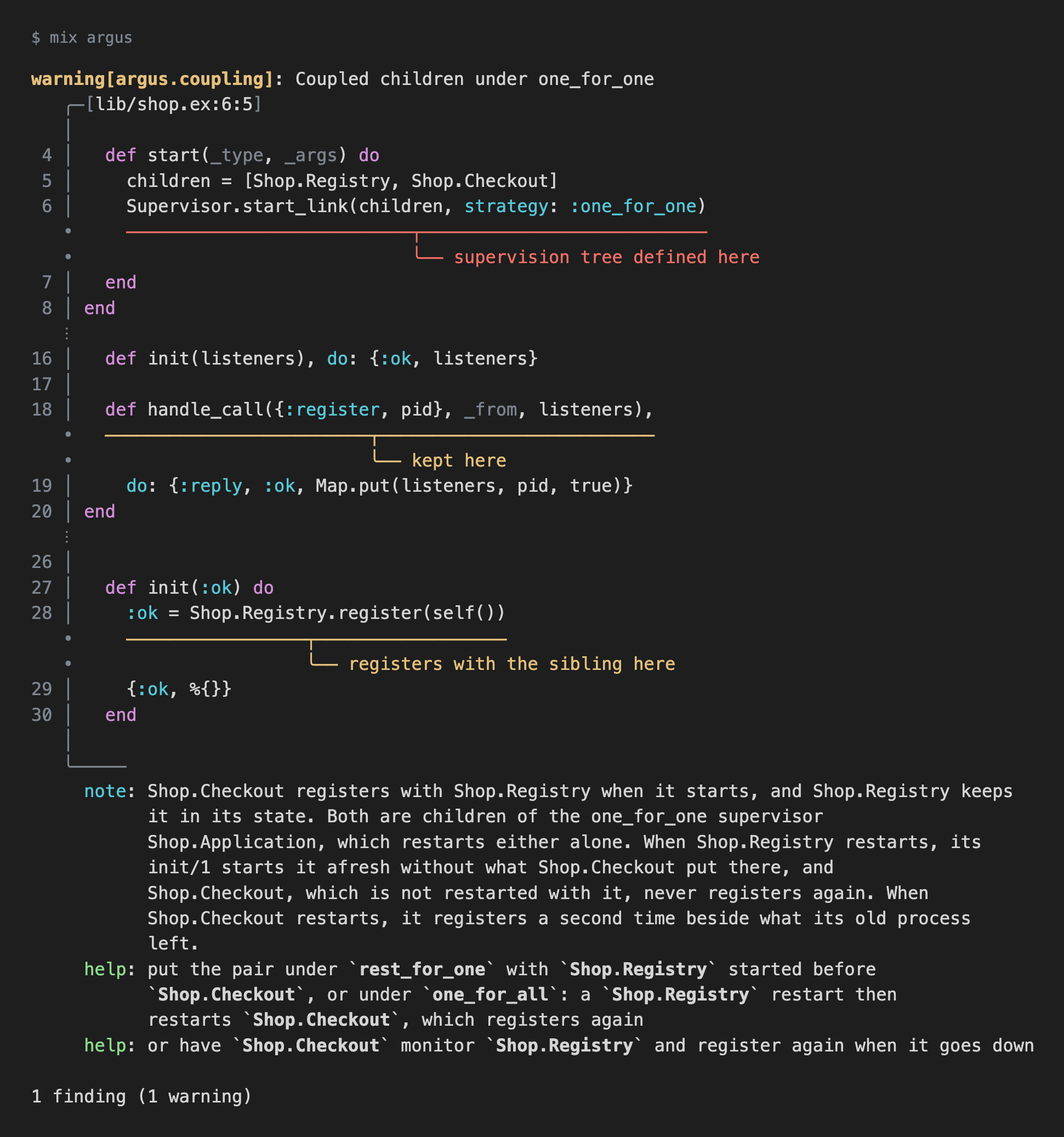
Install Soufflé on your PATH. The Mix
integration requires Elixir 1.19 or later; prebuilt escripts require Erlang/OTP 28.
Add Argus to your dependencies:
def deps do
  [
    {:argus_beam, "~> 0.20"}
  ]
end
Then fetch dependencies and run an analysis. mix argus compiles the project first.
mix deps.get
mix argus                 # configured analyses, or the default set
mix argus coupling ets    # selected analyses
mix argus --all           # all bug-finding analyses
mix argus --list          # available analyses and sets
mix argus --format json   # findings as JSON
mix argus --fail-above 0  # fail CI on any finding
To report findings on every compile, append the :argus compiler. Editors can
show the findings as compiler diagnostics.
def project do
  [
    compilers: Mix.compilers() ++ [:argus],
    argus: [analyses: [:default, :ets], severity: [mailbox: :error]]
  ]
end
By default, error findings fail the compiler run. mix argus uses --fail-above
to decide whether findings fail the run.
Add this to rebar.config, then run rebar3 argus. The plugin compiles the
project and downloads the specified Argus escript.
{plugins, [rebar3_argus]}.
{argus_plugin, [{version, "0.20.1"}]}.
{argus, [{analyses, [default, ets]}]}.           % optional
{provider_hooks, [{post, [{compile, argus}]}]}. % optional: run after compilationInstall the escript with Mix:
mix escript.install hex argus_beamOr download a prebuilt escript and its SHA-256 checksum from
GitHub releases. Put argus on
your PATH.
Build your project, then run:
argus                                 # current project
argus path/to/project --all
argus --project beams --ebin path/to/ebin
The escript reads existing BEAM files and warns about sources newer than their
compiled files. Configuration goes in argus.config as Erlang terms. Gleam
findings point to the generated Erlang source.
The analyses marked ✓ run by default.
| Analysis | Finds | Default |
|---|---|---|
startup |
blocking work, deadlocks and races during initialization | ✓ |
shutdown |
skipped cleanup and teardown that disrupts a peer | ✓ |
coupling |
processes that depend on each other but restart independently | ✓ |
structure |
invalid child specs, conflicting registrations and supervision mistakes | ✓ |
mailbox |
unhandled messages, missing replies and repeated resource acquisitions | ✓ |
failure |
swallowed errors, unchecked results and dropped resources | ✓ |
races |
check-then-act races on registered names, ETS keys or Mnesia records | ✓ |
blocking |
call cycles, nested waits, bottlenecks and unsafe distributed calls | |
state_machine |
unreachable gen_statem states and terminal states that never stop |
|
ets |
table ownership, lifecycle and access-pattern problems | |
effects |
violated @pure contracts and effects a transaction cannot undo |
|
unsafe_input |
atom exhaustion, unsafe deserialization and code execution | |
exposure |
inspect-visible secrets and TLS connections without peer verification |
Use analysis names or these sets in analyses::
:default: the analyses marked ✓;:all: every analysis in the table;:security:unsafe_inputandexposure;:effects:effects;:otp::allexcept:securityand:effects.
The separate coverage analysis reports missing analysis information. Request it
explicitly; --all excludes it.
severity: overrides the level for an analysis or set. See the
configuration reference for
severity, ignore rules and compiler settings.
Argus analyzes your project's code by default. Add --include-deps to analyze
dependencies too. Dynamic calls and runtime configuration can leave gaps or
produce findings that do not apply to a particular deployment.
Use the bug-class catalog to understand each finding's evidence and limits. For contributors, the analysis model and rule guide explain the implementation.
MIT
