
Compotastic is a hackathon exploration of how ultra-low-power, Meshtastic-enabled devices could pool compute for robotic field work. The repository hosts a simulation-only stack: a Python backend and a Phaser UI mirror the behaviours of deployed nodes so developers can debug coordination logic before touching firmware on the real Q-learning mesh cats and the Compote service dog. Simulation AI Simulation UI
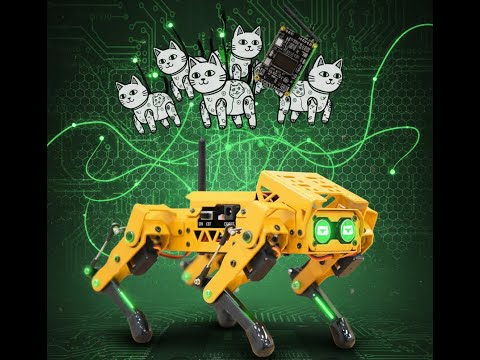
There is also the logic to run the commands over the Mesh and connect it to the backend, this works without flashing firmware and can be found in mesh_connector
- Protocol simulation backend – The FastAPI service under
backend/drives a grid-world environment, synthesises node telemetry, and manages reinforcement-learning state transitions that stand in for the behaviour of on-device agents. backend/api/app.py backend/simulation/runtime.py - Q-learning agents – Each simulated node owns a compact integer-based Q-table, allowing the runtime to practise policy updates and reward distribution exactly as the embedded firmware will apply them when Compote ferries new experience across the mesh. backend/simulation/logic/init.py backend/simulation/runtime.py
- Meshtastic connector prototype – The
mesh_connector/package adds a protobuf envelope (AddressableMeshData) that piggybacks on Meshtastic packets to move bin-packed state replicas and coordination requests with minimal airtime. mesh_connector/protos/mesh_connector.proto - Capability beacons – Every simulated node advertises its accelerators, model support, and energy status through BLE GATT metadata so peers can negotiate workloads and Compote can prioritise which partner to aid. backend/README.md
- Web-based visualiser – The Phaser/Vite UI consumes websocket snapshots to animate the grid, making it easier to narrate how the dogs push firmware and how cats resume their jobs once updated policies arrive. ui/README.md backend/simulation/runtime.py
Together, these components illustrate how the real deployment will coordinate Bluetooth and mesh radios without risking physical hardware during rapid iteration.
- Compotastic protobuf extension –
StateUpdateframes align with theGridWorldEnvironment.steptuple, letting embedded learners apply the same compressed updates when they receive deltas over Meshtastic or from Compote directly. mesh_connector/protos/mesh_connector.proto backend/simulation/logic/init.py - State replication & job signalling – The connector binds source/destination addresses and sequence IDs so mesh nodes can deduplicate packets, react to compute help requests, and merge Q-learning tables even when connectivity is intermittent. mesh_connector/protos/mesh_connector.proto backend/simulation/runtime.py
- GATT for capability discovery – Metadata broadcasts over BLE advertise GPU/NPU availability, firmware versions, and power budget, giving Compote the context it needs before it attempts an OTA push. backend/README.md
+-----------------+-----------------+-----------------+-----------------+
| Node A (Cat-07) | Node B (Dog-02) | Node C (Cat-11) | Node D (Cat-04) |
|-----------------|-----------------|-----------------|-----------------|
| Status: NEEDS   | Status: EN ROUTE| Status: WANDER  | Status: TASK    |
| compute assist  | to assist       | patrol          | monitoring crop |
|-----------------|-----------------|-----------------|-----------------|
| Q-load: 92%     | Q-load: 35%     | Q-load: 40%     | Q-load: 58%     |
| Battery: 54%    | Battery: 88%    | Battery: 67%    | Battery: 73%    |
| BLE RSSI: -63 dB| BLE RSSI: -48 dB| BLE RSSI: -71 dB| BLE RSSI: -66 dB|
| Help vector:    | Dispatch role:  | Wandering path: | Task: soil      |
| FFT inference   | Q-table merge   | perimeter sweep | moisture probe  |
| ETA: n/a        | ETA: 02:15 min  | ETA: n/a        | ETA: 06:40 min  |
+-----------------+-----------------+-----------------+-----------------+
The ASCII grid mirrors the runtime telemetry: Cat-07 publishes a NEEDS compute assist advertisement through the protobuf envelope, Dog-02 acknowledges over Meshtastic before navigating via BLE ranging to perform a Q-table merge, while Cat-11 keeps wandering for weak-signal peers and Cat-04 stays on task sampling soil moisture. This is the same flow Compote will orchestrate on-device once firmware promotion moves beyond the simulator. backend/simulation/runtime.py mesh_connector/protos/mesh_connector.proto
Top-down situational map:
            +-----------+                      +-----------+
            | Cat-11    |                      | Cat-04    |
            | Wander    |                      | Task Soil |
            +-----------+                      +-----------+


            +-----------+             +-----------+
            | Dog-02    |------>      | Cat-07    |
            | En Route  |  assist     | Needs Help|
            +-----------+             +-----------+
Dog-02’s path arrow shows the compute caravan moving across the grid to deliver a Q-table merge to Cat-07 while the other cats maintain their patrol and task assignments.
Meshtastic’s LoRa transport excels at ultra-long-range telemetry, but its data rates (often 0.3–37.5 kbps depending on spreading factor) and multi-second airtime per frame make large binaries impractical. Firmware images for Compotastic nodes quickly exceed LoRa’s effective throughput, so full updates would monopolise the shared mesh and risk missed safety-critical telemetry. Bluetooth Low Energy avoids those constraints: Compote can sidle up to a node, use BLE to transfer multi-hundred-kilobyte firmware within minutes, and then let Meshtastic resume its speciality—broadcasting compact state deltas, coordination pings, and reward updates.
The current simulation and Phaser visualiser were invaluable teaching aids, but the project’s next phase retires these demos in favour of a production-grade embedded implementation:
- Transition firmware to MLIR – LLVM’s Multi-Level IR provides dialect specialisation, aggressive shape-aware optimisation, and pluggable lowering pipelines that can squeeze every cycle from heterogeneous microcontrollers while remaining portable across vendors.
- Custom dialects for Compotastic kernels – Encode reinforcement-learning primitives, GATT advertisement packing, and radio orchestration as MLIR dialects so they can be optimised alongside conventional tensor ops before lowering to target ISAs.
- Firmware update pipeline overhaul – Replace ad-hoc Python packaging with an MLIR-to-bare-metal toolchain that emits OTA-ready binaries tailored to each node’s capabilities and memory limits.
- TensorFlow Lite trade-off acknowledgement – TensorFlow’s micro runtime is a strong baseline, but its arena allocator typically demands >1 MB of pre-reserved RAM, excluding the majority of LoRa-focused boards we plan to support; MLIR lets us deliver equivalent kernels without that footprint.
By narrowing scope to the embedded stack, Compotastic can evolve from a didactic simulator into a resilient compute mesh that pushes frontier models to wherever Compote roams.
The remaining instructions help you run the simulation for storytelling or regression testing.
cd backend
python3.12 -m venv .venv
source .venv/bin/activate
python -m pip install --upgrade pip
pip install -r requirements.txt

# Start the simulation backend
python simulation/main.pycd ui
npm install
# Start the Vite development server
npm run dev
# Build the production bundle
npm run buildThis project is distributed under the terms of the MIT License.
